Understanding Your Forklift’s Most Important Safety Information
When it comes to forklift safety, one of the most important pieces of information is often overlooked: the forklift data plate.
Also known as the capacity plate, the forklift data plate provides critical information about how much weight a forklift can safely lift under specific operating conditions. Misunderstanding or ignoring this information can lead to equipment damage, product loss, serious injuries, or even fatalities.
In this training video, Dennis Richardson, Training Manager at W.D. Matthews Machinery, explains how operators can read and understand their forklift’s data plate to help ensure safe operation and OSHA compliance.
Watch the Training Video: How to Read a Forklift Data Plate & Determine Capacity
What Is a Forklift Data Plate?
A forklift data plate is a manufacturer’s label typically located near the operator compartment. It contains important specifications about the forklift, including:
- Maximum lifting capacity
- Load center information
- Lift height limitations
- Fork length specifications
- Attachment information
- Truck weight
- Model and serial number
The information on the data plate tells operators exactly how the forklift was designed to perform and under what conditions it can safely handle a load.
Why Forklift Capacity Changes
One of the most common misconceptions is that a forklift can lift its maximum rated capacity in every situation.
In reality, forklift capacity can change based on several factors:
Load Center Distance
The farther a load’s center of gravity moves away from the mast, the less weight the forklift can safely lift.
Lift Height
The data tag tells you max you can lift to the maximum lift height with a vertical mast not traveling.
Attachments
Adding attachments such as carton clamps, rotators, or fork positioners can significantly affect a forklift’s lifting capacity. Operators should always verify attachment information on the data plate.
Load Dimensions
Long, oversized, or uneven loads can shift the center of gravity and impact safe lifting limits.
How to Read a Forklift Data Plate
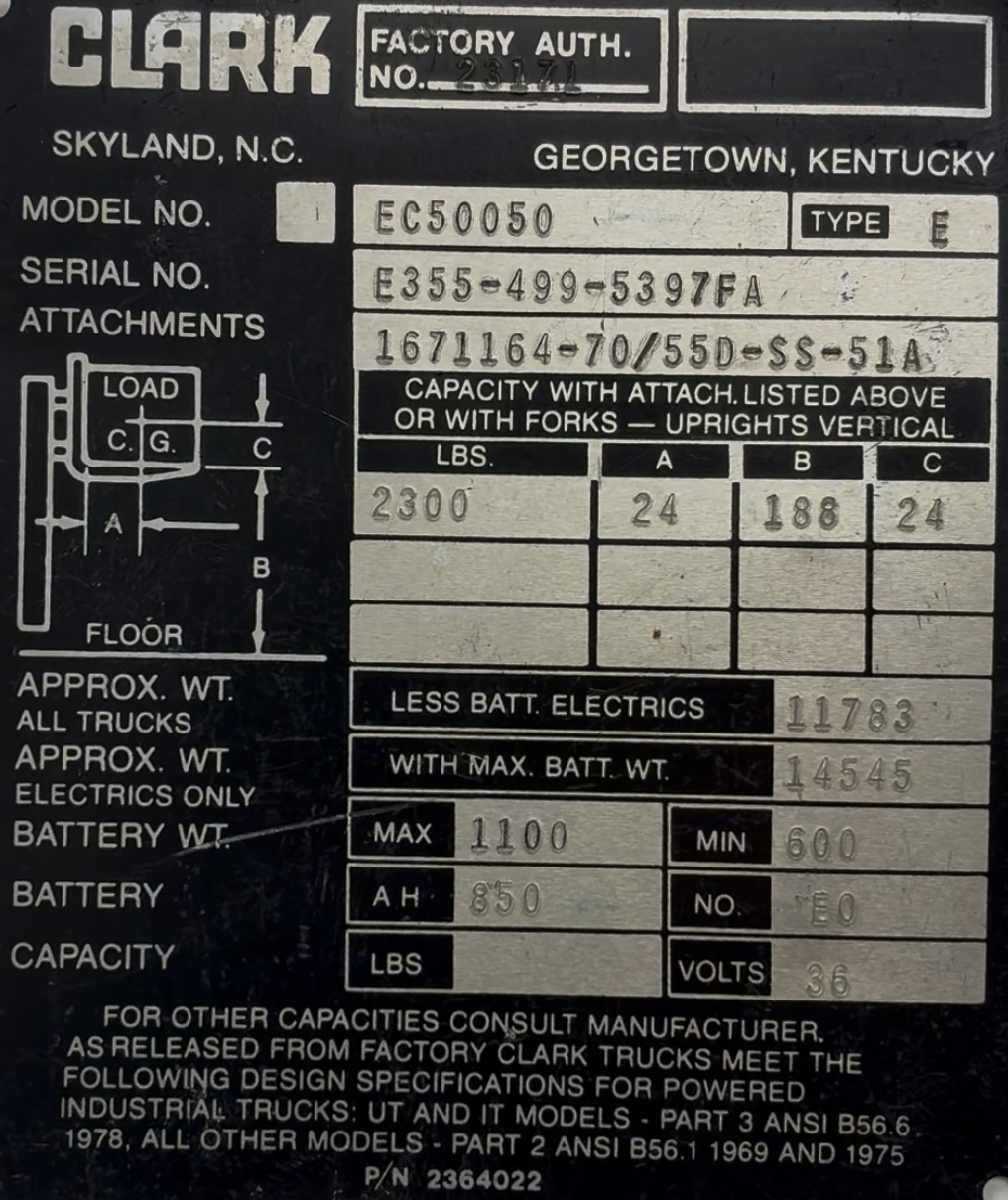
When reviewing a forklift data plate, operators should pay attention to:
Rated Capacity
This indicates the maximum weight the forklift can safely lift under specified conditions.
Load Center
The load center measurement helps determine whether a load’s weight distribution falls within the forklift’s design limits.
Lift Height
The data plate may provide multiple capacity ratings depending on the height at which the load is being lifted.
Attachment Information
If attachments have been installed, the data plate should reflect the adjusted lifting capacity.
Common Mistakes Operators Make
Many forklift accidents occur because operators:
- Assume all forklifts have the same capacity
- Ignore attachment limitations
- Lift loads without checking weight
- Fail to understand load center requirements
- Operate equipment without reviewing the data plate
Proper training helps operators recognize these risks and make safer decisions on the job.
OSHA Compliance and Forklift Training
OSHA requires forklift operators to be properly trained and evaluated before operating powered industrial trucks.
Understanding how to read a forklift data plate is a key component of operator safety training and can help reduce workplace incidents while improving productivity.
Learn More with W.D. Matthews Training
At W.D. Matthews Machinery, our OSHA-compliant forklift training programs help operators develop the knowledge and confidence needed to work safely and efficiently.
Whether you’re training new employees, scheduling recertifications, or improving workplace safety, our experienced trainers provide practical instruction tailored to your operation.
Contact W.D. Matthews Machinery today to learn more about forklift operator training, equipment safety programs, and workplace compliance solutions throughout Maine, New Hampshire, Massachusetts, and Eastern Vermont.
Forklift Data Plate FAQ
What is a forklift data plate?
A forklift data plate, also called a capacity plate, is a manufacturer’s label that provides important information about the forklift’s lifting capabilities, load center, lift height, and approved attachments.
Where is the data plate located on a forklift?
Most forklift data plates are located in the operator compartment, near the dashboard, under the overhead guard, or beside the seat where they are easily visible to the operator.
Why is a forklift data plate important?
The data plate tells operators how much weight a forklift can safely lift under specific conditions. Ignoring the information on the data plate can lead to tip-overs, dropped loads, equipment damage, and serious injuries.
How do I know my forklift’s lifting capacity?
The rated lifting capacity is listed on the forklift’s data plate. Capacity can vary depending on lift height, load center, and attachments installed on the truck.
What is a load center on a forklift?
A load center is the distance from the face of the forks to the center of gravity of the load. As the load center increases, the forklift’s lifting capacity may decrease.
Do forklift attachments affect lifting capacity?
Yes. Attachments such as carton clamps, rotators, side shifters, and fork positioners can reduce a forklift’s lifting capacity. The data plate should reflect the truck’s capacity with the attachment installed.
Can I operate a forklift if the data plate is missing or unreadable?
No. OSHA requires forklifts to have a legible data plate. If the plate is missing or damaged, the forklift should be removed from service until a replacement is obtained from the manufacturer.
Why does forklift capacity decrease at higher lift heights?
As the load is raised, the forklift’s center of gravity changes. This can reduce stability and affect the maximum safe lifting capacity.
How often should operators review the forklift data plate?
Operators should review the data plate whenever they operate a different forklift, use an attachment, or handle loads that may approach the truck’s rated capacity.
Is forklift training required by OSHA?
Yes. OSHA requires forklift operators to receive formal training, practical instruction, and an evaluation before operating powered industrial trucks.
How long does forklift certification last?
OSHA requires operators to be evaluated at least once every three years, although additional training may be required if workplace conditions change or unsafe operation is observed.
What happens if a forklift is overloaded?
Overloading can cause the forklift to become unstable, tip over, lose steering control, damage equipment, or drop the load, creating a serious safety hazard.
Does every forklift have the same lifting capacity?
No. Forklift capacities vary significantly based on the make, model, mast configuration, lift height, and attachments.
Who can provide forklift safety training in New England?
W.D. Matthews Machinery offers OSHA-compliant forklift operator training, train-the-trainer programs, aerial lift training, and workplace safety education throughout Maine, New Hampshire, Massachusetts, and Eastern Vermont.