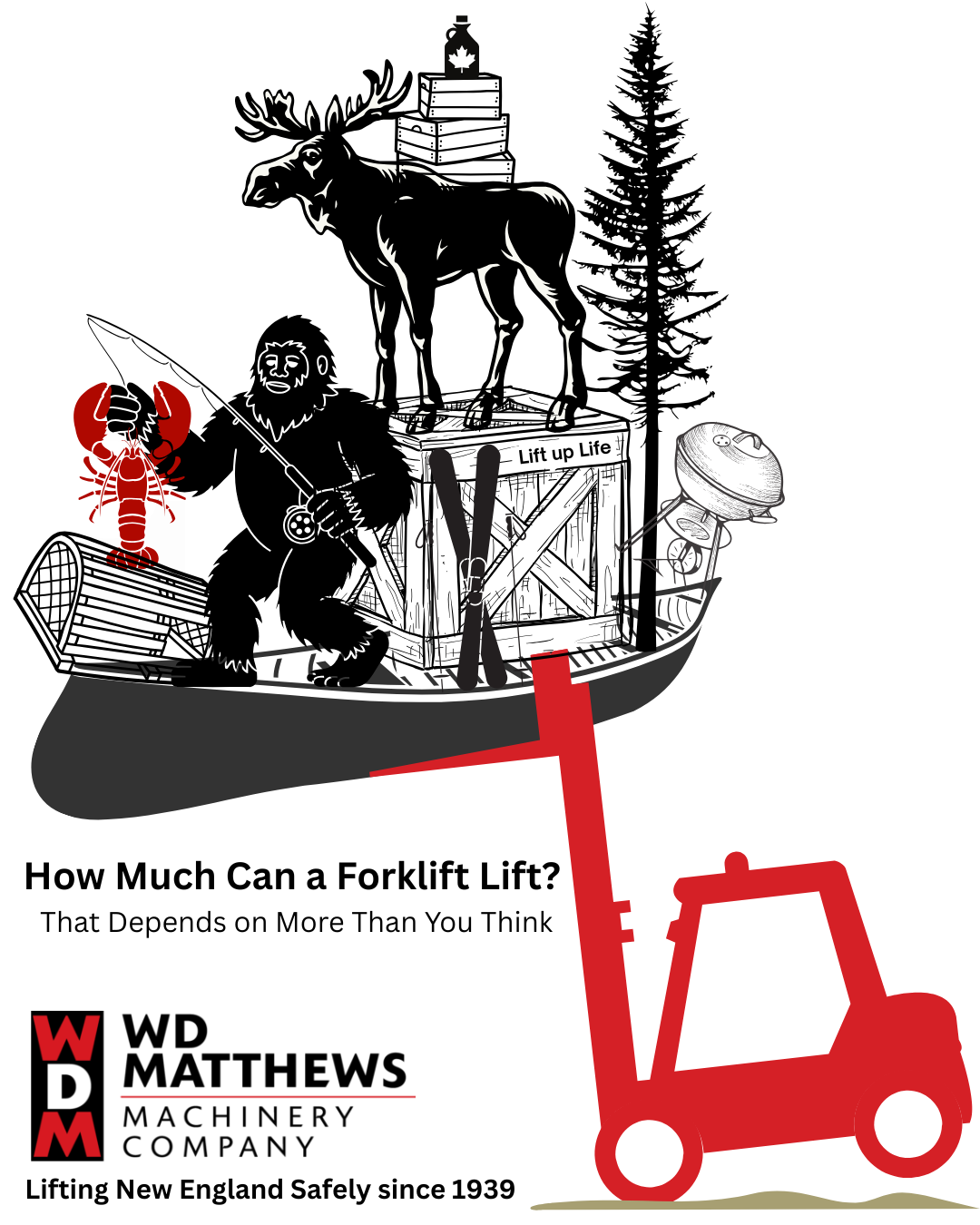
From New England warehouses to muddy construction sites, forklifts are built to lift, stack, transport, and move heavy materials. But just because a forklift looks powerful enough to handle a load does not mean it can safely lift it.
So, how much can a forklift lift?
The answer depends on several factors, including the forklift’s rated capacity, load center, lift height, attachments, and the size and distribution of the load.
How Much Weight Can a Forklift Lift?
A forklift’s lifting capacity is listed on its data plate, also called a nameplate or capacity plate. This information tells the operator the maximum weight the truck can safely lift under specific conditions.
For example, a warehouse forklift might be rated at 5,000 pounds at a 24-inch load center.
That does not mean the forklift can lift 5,000 pounds in every situation. The 5,000-pound rating applies when the load’s center of gravity is positioned at the specified 24-inch load center and the other conditions shown on the data plate are met.
That distinction matters.
A load that is longer, unevenly distributed, lifted higher, or handled with an attachment can reduce the forklift’s actual allowable capacity.
What Is a Forklift Load Center?
The load center is the horizontal distance from the vertical face of the forks to the center of gravity of the load.
In simple terms, the farther the weight extends away from the forklift, the more leverage the load creates.
Think about carrying a heavy box. Holding it close to your body is easier than holding that same box with your arms fully extended. A forklift works on a similar principle.
For example, a forklift rated at 5,000 pounds with a 24-inch load center may have a lower allowable capacity when the load center extends beyond 24 inches. The exact capacity must be determined using the forklift manufacturer’s specifications and data plate rather than guessed.
The farther the load’s center of gravity moves from the mast, the greater the load moment and the greater the effect on forklift stability.
Why the Forklift Data Plate Matters
Before lifting a load, operators should check the forklift’s data plate.
The plate provides important information about the truck, including its rated capacity, load center, maximum lift height, and, when applicable, capacity changes caused by attachments.
OSHA specifically advises operators to understand the information on the nameplate and never exceed the truck’s rated capacity. A forklift with an illegible or missing nameplate should not be operated.
The data plate is more than a sticker on the forklift. It is one of the most important tools an operator has for determining whether a lift can be performed safely.
What Factors Affect Forklift Capacity?
Several conditions can change how much a forklift can safely lift.
Load Center
A load center that extends beyond the rated distance can reduce the forklift’s allowable capacity.
Lift Height
The maximum allowable load can change as the forks are raised. Always check the capacity listed for the specific lift height and configuration.
Forklift Attachments
Attachments such as clamps, rotators, sideshifters, paper roll clamps, and extensions can affect capacity, stability, visibility, and the forklift’s center of gravity. Attachments can also add weight to the truck’s load-handling system.
Load Size and Weight Distribution
A load’s total weight is only part of the equation. Its size, shape, position, and weight distribution also affect stability.
An uneven or oversized load may have a different center of gravity than a standard pallet load. As a result, the forklift may not be able to safely handle the same weight shown on its standard capacity rating.
Ground Conditions and Tires
Operating conditions also matter. Uneven surfaces, poor ground conditions, and equipment configurations that are not suited to the application can affect stability and safe operation.
For outdoor jobs throughout Maine, New Hampshire, and Massachusetts, choosing the right forklift for the terrain and application is especially important.
Can a 5,000-Pound Forklift Lift 5,000 Pounds?
Not necessarily.
A forklift rated for 5,000 pounds can safely lift up to 5,000 pounds only when the load, load center, lift height, attachments, and other conditions match the manufacturer’s rated configuration.
If the load center changes or an attachment reduces capacity, the forklift’s allowable lifting capacity may be lower.
That is why operators should never assume that the number on the forklift represents its capacity for every lift.
Instead, check the data plate and follow the manufacturer’s operating instructions.
Forklift Capacity Tips From the Field
At W.D. Matthews, we have been helping New England businesses find and maintain material handling equipment since 1939.
When it comes to safe load handling, remember these basic practices:
- Check the data plate before lifting.
- Know the weight of the load.
- Keep the load as close to the mast as practical.
- Center the load on the forks whenever possible.
- Account for attachments and their effect on capacity.
- Do not exceed the rated capacity.
- Follow the manufacturer’s operating instructions.
- Get help when a load is oversized, irregular, or difficult to evaluate.
OSHA recommends keeping loads centered, placing the heaviest portion toward the front wheels, and never exceeding the stated capacity of the forklift.
The Bottom Line: Forklift Capacity Is About More Than Weight
So, how much can a forklift lift?
It depends on the forklift and the conditions of the lift.
A forklift’s rated capacity is based on specific factors such as load center and lift height. The actual load’s weight, size, position, distribution, and any attachments can change how much the machine can safely handle.
In other words, 5,000 pounds on the data plate does not automatically mean 5,000 pounds in every situation.
Smart operators understand the relationship between load weight, load center, and stability. They check the data plate, evaluate the load, and never take chances with an overloaded forklift.
Need Help With Forklift Capacity or Training?
Whether you operate a warehouse in Maine, a manufacturing facility in New Hampshire, or a construction site in Massachusetts, W.D. Matthews Machinery Company can help you find the right equipment and support your material handling operation.
Since 1939, W.D. Matthews has served businesses throughout New England with forklifts, equipment, parts, service, rentals, inspections, and operator training.
Not sure what your forklift can safely handle? Need help understanding a data plate, choosing an attachment, or arranging forklift training?
Contact W.D. Matthews Machinery Company to learn more about forklift equipment, training, service, and material handling solutions throughout Maine, New Hampshire, and Massachusetts.
Contact us for more on Forklift training We’re local. We’re experienced. And we know forklifts like operators know the feel of a solid safe lift. Contact Us – WD Matthews Machinery Company in ME, NH and MA